Today, I'll explain in detail whether or not it's necessary to clean a three-way catalytic converter regularly.
What is a three-way catalytic converter? How important is its function?
First, let's do some basic science. A three-way catalytic converter is a key device in a car's exhaust system.
Its function is to convert harmful gases such as carbon monoxide (CO), hydrocarbons (HC), and nitrogen oxides (NOx) emitted by the engine into harmless carbon dioxide, water, and nitrogen.
You can think of it as the car's "lungs," purifying exhaust gases and protecting the environment through oxidation-reduction reactions.
The internal structure of a three-way catalytic converter is like a densely packed honeycomb, with the inner walls of the pores coated with precious metal catalysts, such as platinum, palladium, and rhodium.
These catalysts are not consumed in the reaction, so theoretically, the lifespan of a three-way catalytic converter can be considered infinite. As long as it's not clogged or damaged, it can basically last the entire life of the vehicle.
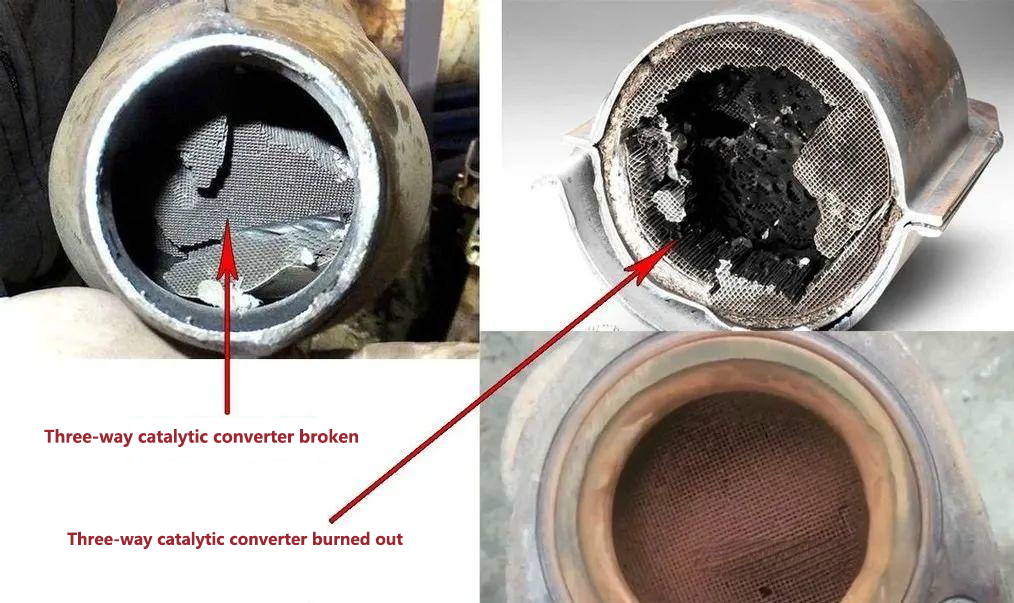
What problems can arise with a three-way catalytic converter?
In theory, three-way catalytic converters have a long lifespan, so why do some cars experience problems with them? This is due to several potential culprits during use.
**Exhaust Particulate Matter Accumulation:** Incomplete combustion in the engine produces unburned carbon particles. These particles adhere to the honeycomb pores of the catalytic converter, gradually clogging it and affecting its efficiency.
**Poor Quality Fuel:** Frequently using low-quality fuel can lead to impurities like sulfur and phosphorus coating the catalyst surface, causing it to fail – essentially, the catalytic converter is "poisoned."
**Overheated Exhaust:** Sometimes, abnormal engine operation can cause excessively high exhaust temperatures, potentially damaging the internal structure of the catalytic converter.
**Mechanical Damage:** Accidentally scraping the bottom of the car while driving can also damage the catalytic converter's outer shell or internal structure.
Does a three-way catalytic converter need regular cleaning?
There are many online advertisements promoting catalytic converter cleaners, and many 4S dealerships also recommend "regular cleaning of the catalytic converter," especially when your car has driven 30,000 to 40,000 kilometers and you're preparing for a major service. The salespeople will enthusiastically recommend, "Clean the catalytic converter!
Otherwise, the car's power will decrease, and fuel consumption will increase..." At this point, are you starting to waver?
Actually, catalytic converters don't need regular cleaning, especially for vehicles without obvious problems. Under normal circumstances, as long as you use qualified fuel and engine oil, the catalytic converter will almost never malfunction.
Furthermore, most of the so-called catalytic converter cleaners on the market rely on acidic substances to corrode carbon deposits. If not handled carefully, this can actually damage the precious metal coating on the catalytic converter, resulting in more harm than good.
So, should you clean the catalytic converter?
My advice is: If your car doesn't have problems like decreased power, abnormal fuel consumption, or poor exhaust flow, then cleaning is completely unnecessary. If you find the engine malfunction light is on and the diagnosis confirms a problem with the catalytic converter, then it's not too late to consider cleaning or replacing it.
User Case: Cleaning Caused More Problems
A while ago, an old friend of mine, Mr. Zhang, experienced this.
His car had 60,000 kilometers on it, and he usually drove it very carefully, filling up with the right amount of gas.
However, during a maintenance visit to the 4S dealership, they suggested cleaning the catalytic converter, saying it was "for engine maintenance and reducing fuel consumption."
Mr. Zhang thought it made sense and had it done.
Less than two weeks later, he suddenly felt a decrease in power while driving, and the exhaust sounded off.
After inspection, it was discovered that the cleaning process may have corroded part of the catalytic converter's catalyst, causing a decrease in its efficiency. In the end, he had to replace it with a new one. Not only did he waste money, but he also wasted a lot of time.
Fellow car owners, blindly cleaning your catalytic converter is really not advisable. Don't mess with it unnecessarily!
Tips: How to Maintain a Catalytic Converter?
Since the three-way catalytic converter is so important, how should we protect it in daily car use? It's actually quite simple, just pay attention to a few points:
1. Use high-quality fuel.
Avoid cheap, unknown gas stations; impurities in inferior fuel are a "killer" of the three-way catalytic converter.
2. Regularly drive on highways.
When driving on highways, the engine maintains a medium-to-high load, with a large exhaust volume and high temperature, which helps burn off carbon deposits and keep the catalytic converter clean.
3. Avoid prolonged idling.
Prolonged idling leads to an increase in carbon particles in the exhaust, easily clogging the catalytic converter.
4. Prevent bottoming out.
Especially for vehicles with low chassis, try to avoid bottoming out when driving on rough roads to prevent damage to the three-way catalytic converter.
Competitive Comparison: The "Environmental Battle" Between Three-Way Catalytic Converters and Electric Vehicles
Speaking of three-way catalytic converters, we must mention electric vehicles.
The core function of a three-way catalytic converter is to reduce pollutants in exhaust gases through a chemical reaction, while electric vehicles have zero emissions and do not need a three-way catalytic converter at all.
While electric vehicles seem to have a significant environmental advantage, I must remind everyone that the carbon emissions during their production and disposal stages are not to be underestimated.
Furthermore, electric vehicle batteries have limited lifespans, and their recycling and disposal costs are very high.
In contrast, many people still prefer traditional gasoline-powered cars, as their maintenance systems are more mature. With proper maintenance, key components like the catalytic converter can last far longer than electric vehicle batteries.
Conclusion: Careful maintenance of the catalytic converter is crucial.
Dear car enthusiasts, choosing a car is like choosing a companion, and using it is like choosing a close friend. The catalytic converter, though seemingly insignificant, is related to the vehicle's environmental performance and your budget.
My advice is simple: don't clean it blindly, and don't be swayed by sales pitches. With proper driving habits, the catalytic converter can easily last you much longer.
How do you usually maintain your catalytic converter?
Welcome to share your experience in the comments section!
Wishing everyone all the best, good health, and effortless success.
Request OEM Manufacturing、Request Sample

Copyright © 2025 LEADAUTO